If you have ever booked a massage and an adjustment in the same week, you have probably wondered whether the order matters. Should the muscles get worked on first so the adjustment goes more smoothly? Or should the adjustment come first so the massage can help everything settle?
It is a fair question, and it comes up constantly. It also has a more interesting answer than most people expect, because the honest response is that the best order depends on what is actually bothering you.
This question has become a lot more practical for our clients recently. Dr. Dana Pausch, DC, of Pausch Chiropractic now sees patients right inside Uptown Haven on NP Ave. For anyone in the Fargo-Moorhead area who has been driving across town between a massage appointment and a chiropractic visit, both are now available under one roof. So let’s talk about how to make the most of that.
First, Why These Two Work Well Together
Massage therapy and chiropractic care get grouped because they are both hands-on approaches to the musculoskeletal system, but they are doing genuinely different jobs. When deciding whether to schedule a massage before or after a chiropractic adjustment, it helps to understand what each therapy targets.
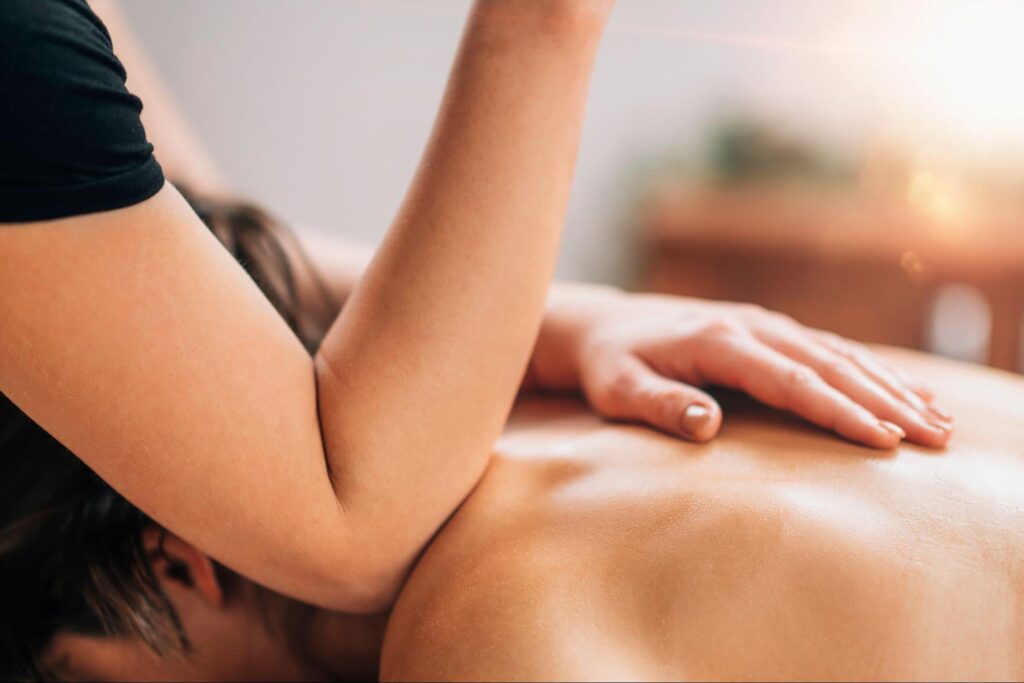
Massage therapy works on soft tissue — muscles, tendons, fascia, and the circulation that feeds them. A skilled therapist can release a knot, break up adhesions, calm an overactive muscle, and increase blood flow to a region that has been guarding itself for weeks.
Chiropractic care focuses on joints and how they move. Chiropractic treatment typically involves manual therapy, most often spinal manipulation, to restore proper motion and function to joints that have become restricted.
Here is why that distinction matters for sequencing: muscles and joints influence each other constantly. A joint that will not move properly forces surrounding muscles to compensate, and those muscles get tight and sore. Meanwhile, a muscle locked in spasm can hold a joint in a restricted position and keep pulling it back there. Treat only one side of that loop and the other side often drags you back to where you started.
That is the real argument for combining the two. The sequencing question is downstream of it.
The Case for Massage First
This is the more common recommendation, and the reasoning is intuitive.
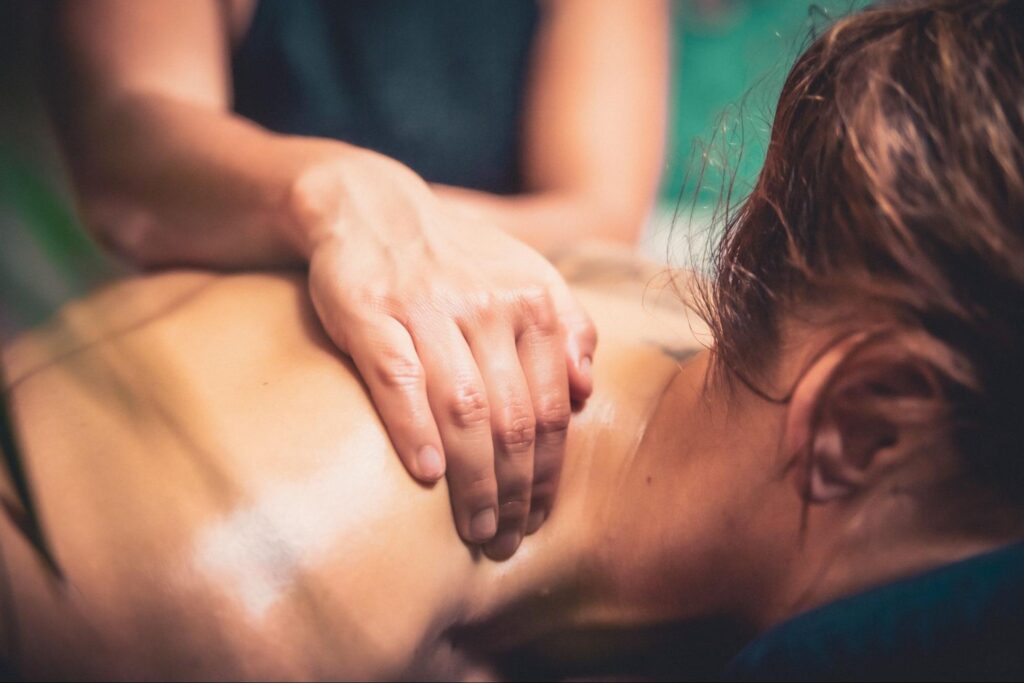
When muscles around a joint are tight and guarded, they physically resist manipulation. Your body reads the adjustment as something to brace against. Loosening that tissue beforehand can make the adjustment more comfortable and give your chiropractor easier access to the joint he is trying to move.
Massage first tends to make sense when:
- You are carrying obvious muscle tension, tight traps, a locked-up lower back, or shoulders living somewhere near your ears
- You are new to chiropractic care and feeling nervous about it
- You tense up during adjustments, which makes them harder to perform
- Your pain feels muscular first, with joint stiffness as the secondary complaint
There is also a nervous system argument. A relaxed body is a more receptive body. If you arrive at your chiropractic appointment already unwound, you are simply easier to adjust.
The Case for Massage After

The reverse order has its own logic, and for some people it is clearly better.
Once a joint is moving properly again, the muscles around it are in a new position. A massage afterward can help that tissue relax into the change rather than yanking things back toward the old pattern. It can also ease the mild soreness some people notice after an adjustment.
Massage after tends to make sense when:
- Your primary complaint is joint restriction rather than muscle tightness
- You have had adjustments before and tend to feel sore afterward
- You are working on a long-standing pattern where your body keeps reverting between adjustments
- You want the session to end on a relaxed, calm note rather than a clinical one
If you have been in chiropractic care for a while and keep finding yourself back in the same spot, following an adjustment with soft tissue work in a massage is often the missing piece.
How to Actually Decide Between Massage and Chiropractic Care
Notice that both cases above are built on clinical reasoning rather than strong research. That is worth saying plainly. The evidence base for massage therapy is uneven — helpful for several kinds of pain, though often for short-term relief — and when evaluating whether to get a massage before or after a chiropractic adjustment, there is no body of research settling the sequencing question one way or the other. Anyone who tells you there is a single correct order is overstating it.
So here is a more useful way to think about it:
Ask what your body is complaining about loudest. If the answer is “everything is tight,” start with massage. If the answer is “something is stuck,” start with the adjustment.
Notice how you respond. Try one order, then the other, and pay attention. Most people develop a clear preference within a few visits, and that preference is better data than any general rule.
Tell both providers what you are doing. This one matters more than the order itself. Dr. Pausch should know you are getting regular bodywork, and your massage therapist should know which areas are under active chiropractic care. That kind of information changes how a session is approached.
Can You Really Do Both in One Day at Uptown Haven?

Yes, and this is where having both services in one building genuinely makes a difference.
Doing both in a single visit means you are not driving between appointments while your muscles cool down and tighten back up. You are not rearranging two separate afternoons. And you get the combined effect while your body is still warm and responsive from the first treatment.
A few practical notes if you want to try it:
- Hydrate. This applies to both, and it is the single easiest thing to get right.
- Do not schedule anything strenuous afterward. Give yourself the rest of the day to be gentle with the work you just did.
- Start conservative. If it is your first time combining them, a general therapeutic massage is plenty. You can always scale up to deep tissue work later.
One scheduling detail worth knowing: Pausch Chiropractic is an independent provider located inside Uptown Haven, so the two appointments will be booked separately. Massage is booked through Uptown Haven at (701) 532-2323 or online here. Chiropractic is booked directly with Dr. Pausch at (701) 640-4117 or through his online scheduling. Two bookings, one address, one morning or afternoon.
Which Massage Pairs Best with Chiropractic Care?
Not every massage is the right partner for an adjustment.
Deep tissue is the most common pairing when there is chronic tension holding a joint hostage. It is targeted, it is thorough, and it goes after the tissue that keeps pulling things out of position.
Therapeutic and targeted massage work well for a specific complaint — sciatic pain, TMJ tension, a stubborn area of the neck — where the goal is resolution rather than relaxation.
Sports massage suits anyone whose issue is training-related, whether you run the Red River Valley trails or spend weekends on the lake.
Relaxation massage is the right call when the underlying driver is stress rather than injury, which is more often the case than people expect.
If you are unsure, say so when you book. Describing the problem in plain language is more useful than picking a service name off a menu.
One Last Thing Worth Checking
Both massage and chiropractic care are appropriate for most people, but not everyone. If you are pregnant, managing a condition like osteoporosis or a bleeding disorder, taking blood thinners, or recovering from a recent injury or surgery, talk with your physician before starting either — and tell both providers about it.
Good care starts with an honest conversation, and that is true no matter which order you book them in.
Ready to try it? Book a massage with our licensed therapists at Uptown Haven, and schedule with Dr. Pausch directly through Pausch Chiropractic. Same building, same morning or afternoon, whichever order suits you